REVIEW · SEOUL
Seoul History Walking Tour
Book on Viator →Operated by CompassTour · Bookable on Viator
Bells, protests, and palaces in one walk. This 3.5-hour Seoul history route strings together Korea’s big turning points with an Australian guide, from Joseon-era power to modern democracy struggles. I like that it connects the past to what you can still see today, and I especially enjoy how Bosingak bells and Gwanghwamun protests put human stories behind the stone and signage.
The other thing I’d call out is the practical value: you get traditional snacks plus an informative memento, and most of the listed sites are admission ticket free. One possible drawback to plan for is that it’s a walking-centered afternoon, so you’ll want comfy shoes and a pace that works for 3 hours 30 minutes.
In This Review
- Key highlights before you go
- A 3.5-Hour History Loop Through Seoul’s Main Story Sites
- Price and Value: Why $26.60 Often Feels Like a Deal
- Bosingak Bell Pavilion: Why City Bells Mattered (Stop 1)
- Cheonggyecheon Stream: From Joseon to War to Modern Seoul (Stop 2)
- Seoul City Hall and Seoul Plaza: Architecture and Civic Mood (Stops 3–4)
- Jeongdong Observatory and Deoksugung Doldam-gil: Views, Walls, and Marriage Myths (Stops 5–6)
- Jungmyeongjeon Hall and Ewha Museum: Loss of Independence and Women’s Education (Stops 7–8)
- Former Russian Legation: A Night Escape That Still Echoes (Stop 9)
- Statues for Admiral Yi Sun-sin and King Sejong: Heroes Through Concrete Symbols (Stops 10–11)
- Gwanghwamun Square, Contemporary History Rooftop, and the Protest Trail (Stops 12–13)
- Embassy of Japan and Jogyesa Temple: Long Protest and Bell Meaning (Stops 14–15)
- What I’d Do Differently: Practical Tips to Get More Out of Each Stop
- Who Should Book This Tour (and Who Might Want Something Else)
- Should You Book the Seoul History Walking Tour?
- FAQ
- How long is the Seoul History Walking Tour?
- How much does the tour cost?
- What time does the tour start?
- Where does the tour start and end?
- What’s included in the price?
- Is bottled water included?
- Is there a mobile ticket?
- How big is the group?
- Are there admission fees for the stops?
- What is the cancellation policy?
- Is the tour near public transportation?
Key highlights before you go
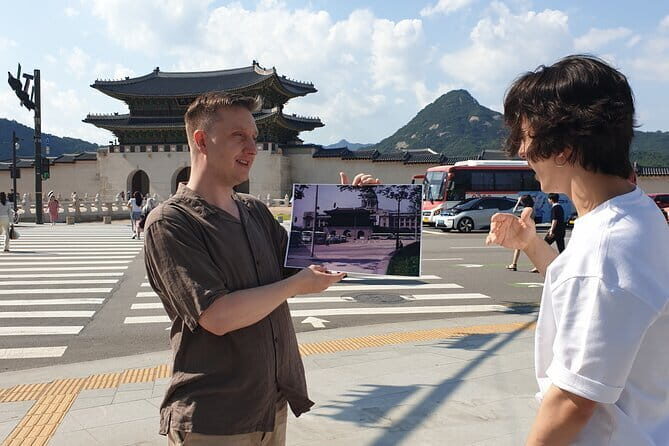
- Up to 8 people: small enough for questions without rushing.
- Free admission at each listed stop: you’re paying mainly for the guide and the story thread.
- Australian guide: you get clear explanations and a coherent timeline across locations.
- Snacks + an informative memento: included extras that make it feel complete.
- Mobile ticket included: less fumbling at check-in.
- Ends near where it starts: a tight route that’s easy to keep exploring after the tour.
A 3.5-Hour History Loop Through Seoul’s Main Story Sites
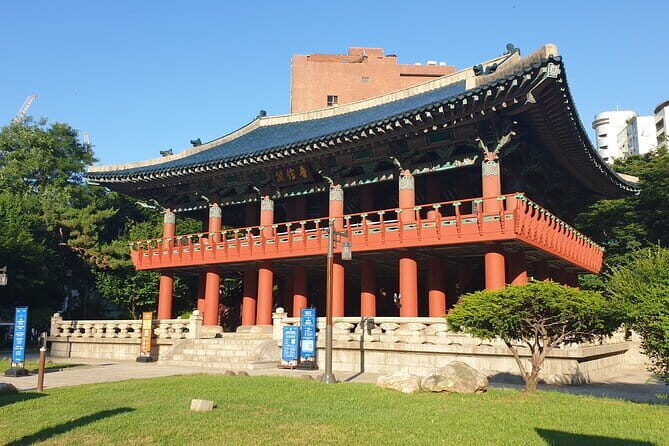
This tour is built as a short, focused circuit through Seoul’s historical center, lasting about 3 hours 30 minutes. It starts at 2:30 pm at the Bosingak Bell Pavilion (54 Jong-ro, Jongno District) and finishes at Jogyesa Temple, with your guide helping you with directions at the end. The time window matters: you get the daytime-to-evening feel as you move through squares, halls, and temples rather than being stuck in one museum room.
One reason I like this format is the pacing. You’re not trying to do everything in Seoul; you’re doing a guided “spine” through the city, so your photos, sights, and street names start to make sense as one connected story. With a max group size of 8 travelers, you’re also more likely to get answers that match what you actually care about (kings, war, democracy, foreign pressure, and social change).
If you want a tour that helps you get oriented fast and then keep exploring on your own afterward, this one fits well.
You can also read our reviews of more walking tours in Seoul
Price and Value: Why $26.60 Often Feels Like a Deal
At $26.60 per person, the math works best when a tour gives you two things: (1) good guiding and (2) enough included value to justify your time. This experience does both.
You’re not paying for a schedule of ticketed attractions—the listed stops are admission ticket free—so the cost is largely about the expert storytelling. Add in traditional Korean snacks and an informative memento, and you’ve got tangible extras rather than just a guided walk. There’s also mention of group discounts and a mobile ticket, which usually makes the whole thing smoother.
Two small “reality checks” that help you plan:
- Bottled water isn’t included. Bring your own or be ready to buy along the way.
- It’s popular enough that bookings happen well ahead of time (the average booking window is 81 days), so don’t wait until the last minute if your dates are fixed.
Bosingak Bell Pavilion: Why City Bells Mattered (Stop 1)
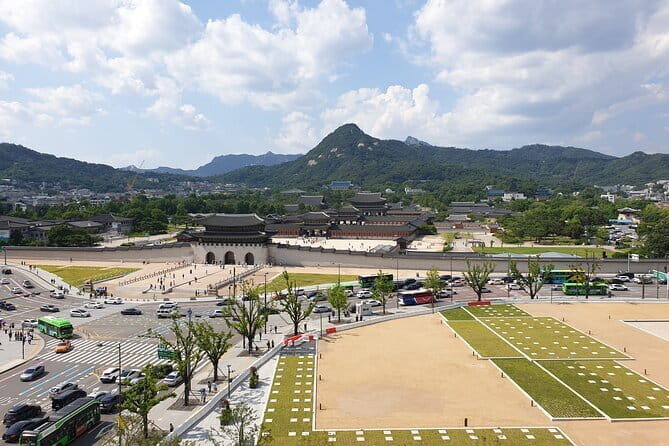
You begin at Bosingak Bell Pavilion, the place that frames one of the easiest ways to understand old Seoul: sound, routine, and public life. The standout question here is simple and powerful: why were the city bells rung 28 times at night and 33 times in the morning?
Even if you’ve never studied Korean history, bells like these are about order—timekeeping, signals, and a shared urban rhythm. Standing near Bosingak, you’re not just looking at a landmark. You’re learning how the city communicated, and why that mattered during different eras.
This first stop is a good warm-up because it sets the tone for the rest of the walk: every stop has a “why,” not just a “what.”
Cheonggyecheon Stream: From Joseon to War to Modern Seoul (Stop 2)
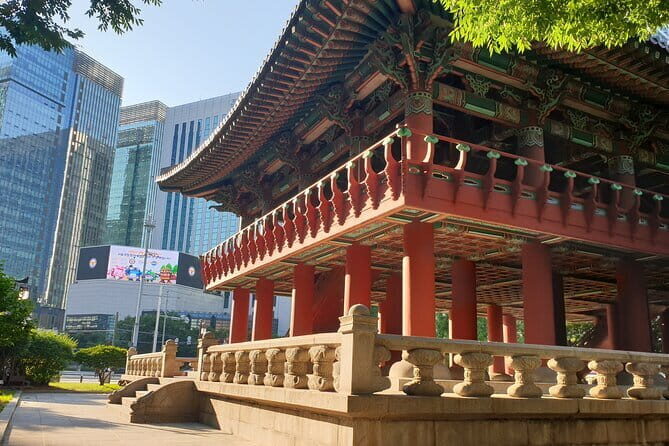
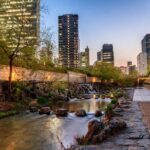
Next comes Cheonggyecheon Stream, a site that turns history into something you can picture in motion. The guiding question is: what did this stream provide Seoul throughout the Joseon Dynasty, Korean War, and modern times?
Streams are never only water. They’re trade routes, life support, boundaries, and memory-makers. By the time you’re standing here, you should be thinking beyond scenery: how a city’s relationship to water changes as power and needs change.
This is also a nice contrast stop—after bells and signals, you get a more flowing, reflective scene. If you enjoy learning how infrastructure shapes daily life, this is a highlight.
Seoul City Hall and Seoul Plaza: Architecture and Civic Mood (Stops 3–4)

Then the tour shifts to the civic heart. You’ll stop at Seoul City Hall and ask: how is Seoul City Hall an architectural gem, inside and out? This is where the story broadens from monarchy and wartime pressures into governance and public identity.
A few steps later you reach Seoul Plaza, where the question becomes more human: how does this plaza reflect the hearts of modern citizens? Plazas are where cities show their values—through gatherings, ceremonies, and the kinds of events people want to be part of.
If you’re a visual learner, these two stops help you connect “history” to the physical layout of Seoul’s modern public space. Even when the details are new compared to palaces or temples, the theme stays the same: power, people, and place.
You can also read our reviews of more historical tours in Seoul

Jeongdong Observatory and Deoksugung Doldam-gil: Views, Walls, and Marriage Myths (Stops 5–6)
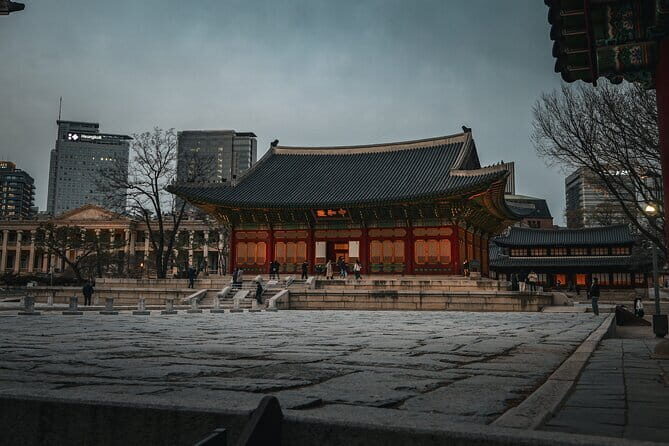
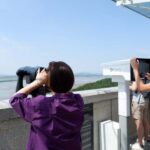
At Jeongdong Observatory, you’ll look for how much of the palace and cityscape reveals itself from this perch. This is a quick stop, but it’s useful. Higher viewpoints give your brain a map, and a map makes the rest of your day easier when you go off on your own.
Then comes Deoksugung Doldam-gil, where you’ll hear a famously dark-silly local warning about love: if you walk along this stone wall with your spouse, you will soon be divorced. The “why” behind that line is the lesson focus here—how myths and sayings latch onto physical spaces. Even if you never plan to test the claim, it gives the area personality.
These two stops work well together because one teaches you to see the city’s shape, and the other teaches you to notice how people add meaning to it with stories.
Jungmyeongjeon Hall and Ewha Museum: Loss of Independence and Women’s Education (Stops 7–8)
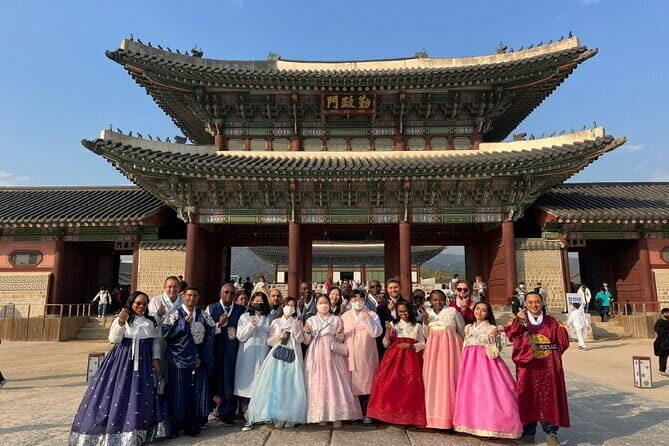
Now the tour turns heavier. At Jungmyeongjeon Hall, the guiding question is blunt: how did Imperial Japan force Korea to surrender its independence? This stop is important because it anchors the later “democracy and protest” theme. Without understanding the earlier loss, it’s harder to grasp why later resistance mattered so much.
From there you move to Ewha Museum, asked through one key lens: how did Korea’s first school for girls change societal views on women’s roles? This isn’t just about education—it’s about who gets to think, lead, and reshape society.
I like that the tour doesn’t treat history as only kings and battles. It gives you a social thread too: independence isn’t only about borders and treaties; it’s also about who has opportunity inside the country.
Former Russian Legation: A Night Escape That Still Echoes (Stop 9)
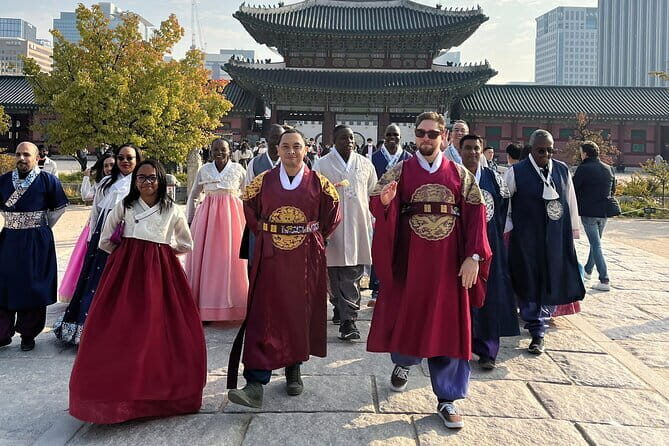
At the Former Russian Legation, the question is dramatic: why did Korea’s penultimate monarch flee his palace in the middle of the night and stay here for a year?
This is one of those places where a single decision can change an entire chain of events. Even without knowing every date, you can feel the tension: flight, uncertainty, foreign shelter, and long waiting. That “why” is exactly the kind of guiding angle that turns a building into a story.
If you like history that includes personal risk and emotional stakes, this stop tends to land well.
Statues for Admiral Yi Sun-sin and King Sejong: Heroes Through Concrete Symbols (Stops 10–11)
The next two stops are short but memorable because they use public art as a historical lesson.
First, a stop at the Statue of Admiral Yi Sun-sin, where the guide frames the question: how did this general save Korea and change the course of world history (no exaggeration)? Whether you already know Admiral Yi or not, the point is that his legacy isn’t treated as local folklore—it’s positioned as globally significant.
Then you move to the Statue of Sejong the Great, with the question: why is Sejong considered the greatest king of the Joseon Dynasty? Sejong is often linked with language and learning, but this tour’s approach is practical: statues are how cities decide what to remember, and Sejong is what Seoul wants you to notice.
These statue stops are good for quick reflection. They also keep the pace moving when you need a breather from more detailed sites.
Gwanghwamun Square, Contemporary History Rooftop, and the Protest Trail (Stops 12–13)
At Gwanghwamun Square, you’ll tackle one of the most direct democracy questions on the route: how many protests does it take to change a democracy. Squares like this aren’t neutral. They’re designed for people to gather—and that makes them central to modern political memory.
Then comes the National Museum of Korean Contemporary History, where the highlight is: how much history can you see from the rooftop. Museums can feel like a slog if you treat them like a checklist. A rooftop viewpoint changes the way you experience it: you see the city and history in the same mental frame.
This pairing—public space for protests plus a museum viewpoint—helps you understand contemporary history as something active. It’s not only what happened; it’s also where people stood to push for change.
Embassy of Japan and Jogyesa Temple: Long Protest and Bell Meaning (Stops 14–15)
Next you reach the Embassy of Japan, introduced through a question about persistence: why is this the site of the world’s longest running protest? That phrase alone signals the tour’s theme: memory and pressure don’t fade quickly just because time passes. This stop helps you see protest as a long arc, not a single day event.
Finally, the tour ends at Jogyesa Temple with a spiritual-sounding question: how does the ringing of bells connect us with the universe. It’s a fitting wrap-up after walking through independence loss, democracy struggle, and the role of public gathering. Bells bookend the experience: sound as timekeeping, sound as meaning.
The route ending near the start makes it convenient. You can keep walking after the tour, grab dinner nearby, or hop to other sights without feeling like you’ve been dropped across the city.
What I’d Do Differently: Practical Tips to Get More Out of Each Stop
If you’re booking this, you’ll probably enjoy it most if you go in with a simple strategy: let each stop answer one big question. The tour is built around those prompts, and they’re what tie the whole arc together.
A few practical moves:
- Bring water since bottled water isn’t included.
- Wear shoes you can walk in for about 3.5 hours.
- Take a photo, then listen. Don’t multitask your ears. The questions are what make the sights click.
- If you’re sensitive to crowds, go slowly at the busier squares so you can still hear the guide.
Who Should Book This Tour (and Who Might Want Something Else)
This works especially well for you if you:
- want a guided timeline across monarchy, colonial pressure, and democracy
- like city walking tours where the guide explains what you’re looking at
- prefer free-entry stops over paying for a pile of separate attractions
- enjoy mixing politics with social history, including education and women’s roles
It may be less ideal if you’re looking for only one era (like “all palaces” or “all modern art”). This tour is intentionally broad from the Joseon Dynasty through contemporary issues, so the value is in the connections.
Should You Book the Seoul History Walking Tour?
Yes, I think you should book it if you want a guided story spine through Seoul’s center without spending extra on entry fees. The $26.60 price feels reasonable because the experience leans on expert explanations, snacks, and an easy-to-follow route where the listed stops are admission ticket free.
Also, the small max group size is a genuine plus. If you like asking questions and getting straight answers, this format tends to deliver. The only real watch-out is the walking time and the lack of included water—plan for that and you’ll be set.
FAQ
How long is the Seoul History Walking Tour?
It runs for about 3 hours 30 minutes.
How much does the tour cost?
The price is $26.60 per person.
What time does the tour start?
The start time is 2:30 pm.
Where does the tour start and end?
It starts at Bosingak Bell Pavilion, 54 Jong-ro, Jongno District and ends at Jogyesa Temple.
What’s included in the price?
The tour includes traditional Korean snacks and an informative memento.
Is bottled water included?
No, bottled water is not included.
Is there a mobile ticket?
Yes, the tour includes a mobile ticket.
How big is the group?
The tour has a maximum of 8 travelers.
Are there admission fees for the stops?
For the stops listed on the tour, the admission tickets are free.
What is the cancellation policy?
You can cancel for a full refund up to 24 hours before the experience’s start time.
Is the tour near public transportation?
Yes, it is near public transportation.