REVIEW · SEOUL
Jinhae Cherry Blossom + Busan Sunrise from Seoul
Book on Viator →Operated by Korea Time Tour · Bookable on Viator
Cherry blossoms in Korea can be a timing game. This tour lines up Jinhae’s most famous viewing areas with a Busan sunrise stop, all wrapped in round-trip transfers from downtown Seoul. I also like that the sightseeing windows are built around the places people actually take photos, including Yeojwacheon Stream and Gyeonghwa Station. One real drawback to plan around: if bloom isn’t fully there yet, the itinerary may be rescheduled or cancelled, and April peak can still move fast.
You’re also not left improvising transport between regions. The schedule uses air-conditioned minivan transfers and gives you two Seoul drop-off options on the return, which matters when you’re arriving late the next day. The only big consideration is energy: this is a night-start tour that comes back without sleep, so it’s not a relaxed, slow sightseeing day.
In This Review
- Key highlights at a glance
- Why this 19-hour cherry blossom run is worth it
- Starting from Seoul: getting to Haeundae without a routing headache
- Haeundae Beach: morning sea air, but manage expectations on food
- Haedong Yonggungsa sunrise: a quiet spiritual stop before the crowds
- Transitioning from Busan to Jinhae: festival energy without arranging your own rides
- Yeojwacheon Stream: the first long blossom viewing block
- Gyeonghwa Station Cherry Blossom Road: second act, stronger chances to catch the look
- The big timing risk: what if blooms are almost over
- Price and logistics: what you’re paying for at $108.49
- Where you’ll land in Seoul at the end of the night
- Who should book this tour, and who should skip it
- Should you book this Jinhae + Busan sunrise day trip?
- FAQ
- How long is the tour?
- What’s included in the price?
- Where do we start and where do we get dropped off in Seoul?
- Is breakfast included?
- What happens if cherry blossoms aren’t fully bloomed?
- Do I get hotel pickup and drop-off?
Key highlights at a glance
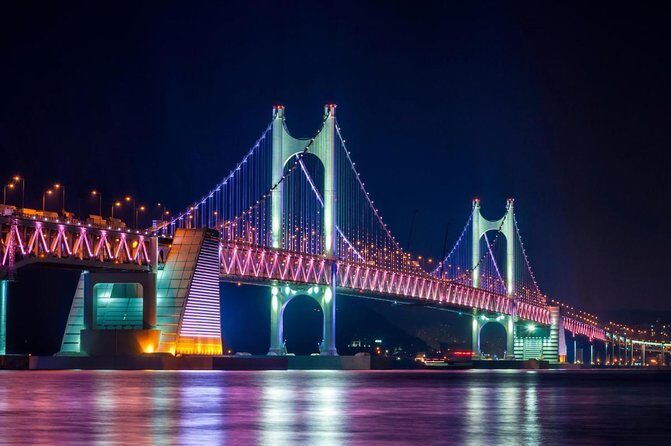
- Jinhae Cherry Blossom Festival viewing: Focus on the main public photo spots rather than random streets
- Yeojwacheon Stream + Gyeonghwa Station: Two separate blossom walks with a combined long viewing window
- Haedong Yonggungsa sunrise: A meaningful early-morning spiritual stop in Busan
- Round-trip transfers from Seoul: Minivan service that saves you the hassle of cross-city logistics
- Mobile ticket: Simple access on the day, especially when you’re moving between multiple areas
Why this 19-hour cherry blossom run is worth it
This is the kind of tour that makes sense when you want results, not stress. Cherry blossom season in South Korea is short, and public viewing areas are spread out. Here, you’re moving from Seoul to the coast, then west-to-south toward Jinhae, with the transport stitched together for you.
The value is in the time savings. Getting from Seoul to Busan area sights, then onward to Jinhae, then back to Seoul, is doable on your own—but doing it well takes planning, routing, and timing. For $108.49 per person, the tour is basically buying you two things: transport and structure.
The trade-off is the pace. The duration is about 19 to 20 hours, and the tour “starts at night and comes back to Seoul on the next day without sleep.” If you’re the type who hates sprinting between photo stops, you’ll feel the marathon.
Still, if you want those iconic blossom corridors and at least one early highlight like sunrise, this route is a very direct way to get there.
You can also read our reviews of more tours and experiences in Seoul
Starting from Seoul: getting to Haeundae without a routing headache
The trip kicks off with a departure from Seoul to Haeundae Beach, taking about 5 hours 20 minutes. Practically, that long transit is the biggest “price you pay” for convenience. You’re not wandering around Seoul first; you’re using the day’s momentum to get to the coast where the schedule can start rolling.
You’ll also want to be sharp on meeting time. The tour asks you to arrive 10 minutes before departure, and latecomers are non-refundable. That’s standard for group tours, but it matters even more here because delays can ripple across the entire chain of stops.
Also, this is designed for comfort. Transfers are done by air-conditioned minivan, and the vehicle type can change depending on the group size. The maximum group size is capped at 100 travelers, so you’re not looking at something chaotic or unmanageable—at least in theory, you should feel like a real group rather than a crowd.
Haeundae Beach: morning sea air, but manage expectations on food
Once you reach Haeundae Beach, you get about 1 hour 20 minutes. The plan includes time to enjoy the beach and mentions free breakfast time, but breakfast itself is not included in the tour.
So here’s the practical mindset: treat this as a chance to reset your energy and grab your own breakfast near where you are. If you show up expecting someone to hand you a meal ticket, you’ll be disappointed.
This beach stop is also useful because it gives you a calmer transition between travel and the early-morning temple plan. Even if you only have a short window, you can still step out, see the coastline, and let your brain catch up before sunrise begins.
Haedong Yonggungsa sunrise: a quiet spiritual stop before the crowds
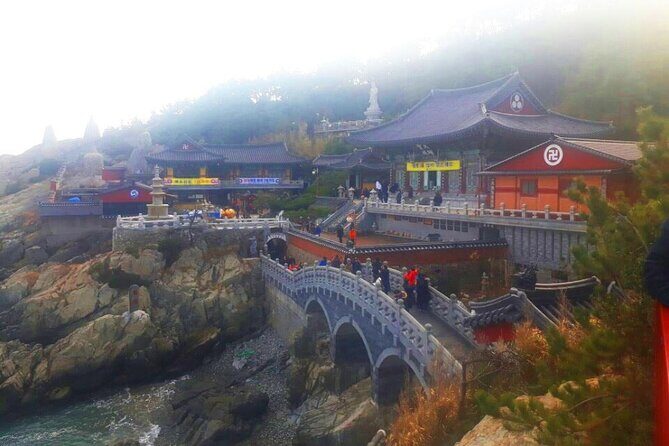
After about 30 minutes of transportation from Haeundae, the tour goes to Haedong Yonggungsa Temple for sunrise. The timing is the whole point here: you’re not just going to a temple, you’re trying to catch the early light.
From a value perspective, sunrise trips are always a gamble in travel planning, but they can be worth it because you’re getting a different mood than the mid-day version. Morning light changes how you experience the space—especially near coastal areas.
One logistical note: this tour structure is compact. You’re moving through multiple regions in one go, so don’t plan to linger for long chats or extra detours. If you love photography, this is the part where you’ll want to show up with your camera settings ready and your timing instincts on.
Transitioning from Busan to Jinhae: festival energy without arranging your own rides
Next comes the move toward Jinhae. The travel time from Busan to Jinhae is about 2 hours 20 minutes, and the schedule tags this phase as part of the Jinhae Gunhangje Festival day.
This is where the tour starts doing its job: it removes the burden of figuring out what to do next. In cherry blossom season, you can waste precious hours hunting for the right bus or train connection. Here, you’re already on the move, so you can spend more time where the petals are.
Also, the itinerary is designed to place your best blossom viewing windows at the places people reliably flock to. That matters because “chasing blossoms” can turn into a frustrating hunt if you’re going solo and the first spot you choose is already fading.

Yeojwacheon Stream: the first long blossom viewing block
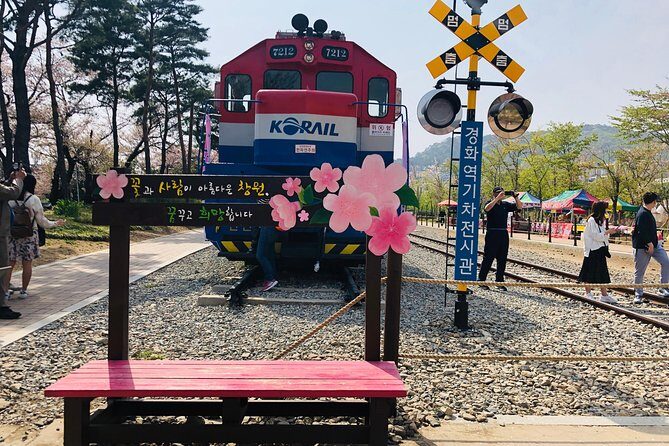
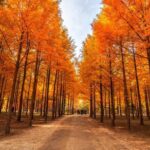
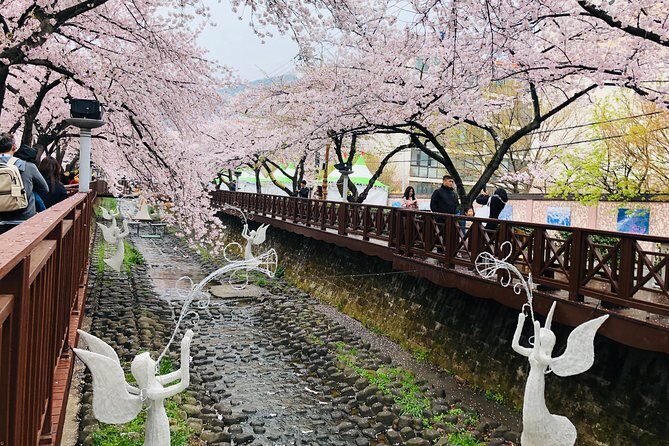
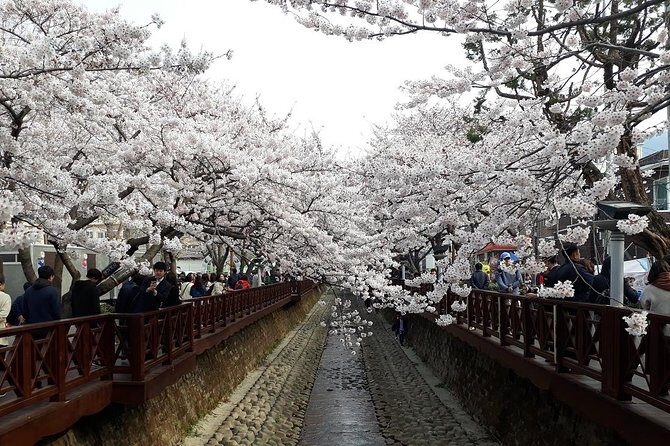
Once you arrive at Yeojwacheon Stream, you get about 2 hours, and this is described as the first place for cherry blossoms. This is one of the more important segments because the tour gives you a longer viewing block rather than a quick photo stop.
The stream setting is usually ideal for slow strolling and stopping as petals drift into the frame. You’re not rushing through a single corridor; you have time to take a breath, walk, and decide where you want to stand.
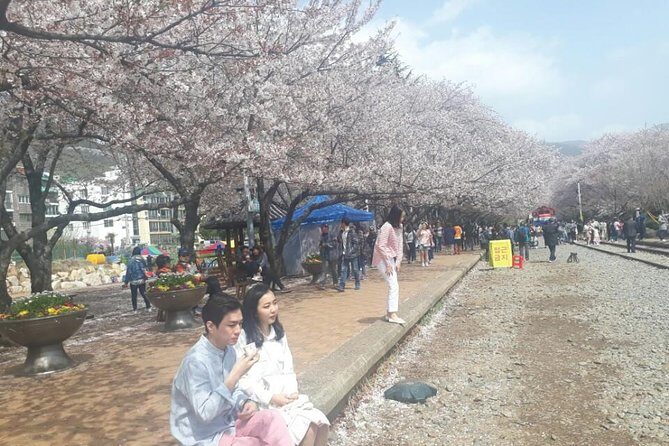
And there’s a useful detail here: the schedule explicitly says you’ll enjoy cherry blossoms at both Yeojwacheon Stream and Gyeonghwa Station for four hours total, not two hours each. Translation: even though the stream is listed as 2 hours and the next station location is also listed as 2 hours, the real experience is treated as one connected blossom session spread across these two famous areas.
Gyeonghwa Station Cherry Blossom Road: second act, stronger chances to catch the look
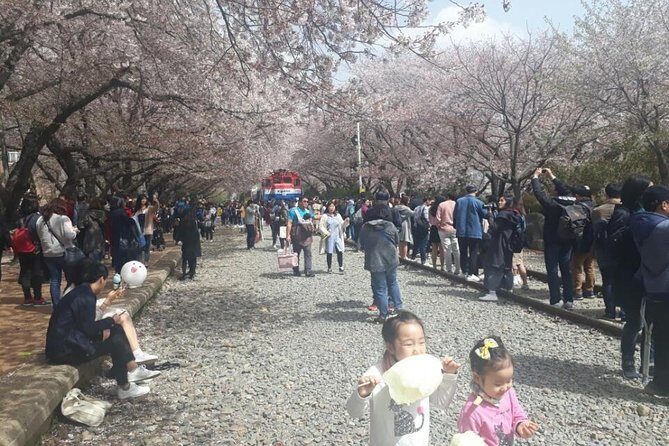
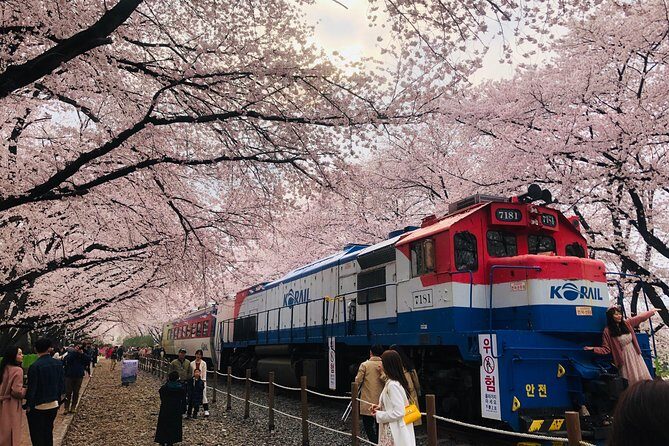
Then you head to Gyeonghwa Station Cherry Blossom Road, with about 2 hours at that second stop.
This is where you should expect the “big signature” cherry blossom vibe. Train-station areas in spring often become magnets because they’re easy to access and built for foot traffic. That makes it great for photos and also great if you just want to blend in and walk the same paths as everyone else.
The value of having two blossom locations is that it reduces the odds of disappointment. If one area feels slightly past its best moment, the other can still deliver. It’s not guaranteed, but it’s better than committing your whole day to one spot.
One thing to keep in mind: your day is long and sleep is limited. When you’re tired, it’s easy to rush. Don’t. This is the section you came for, so pace yourself. Step away from the densest crowd for a moment if you want a calmer look at the trees.
The big timing risk: what if blooms are almost over
There’s no getting around it: cherry blossom peak can shift. Even the best planning can’t stop weather from changing the timeline.
This tour addresses the issue with a clear safety net: if the cherry blossoms are not fully bloomed, the tour can be rescheduled or cancelled, and the supplier will contact you in advance. Also, the tour can be affected by extreme weather or other unforeseen events, but not by participant sickness or simple day-to-day rain.
What you should do with this information is simple: be realistic with your expectations. If you’re booking around late season, the risk is higher that you’ll see fewer blossoms than the photos you’ve been dreaming about.
A practical move: if you’re going during a period where blooms can be tight, pack your mindset for “beautiful pink trees,” not necessarily “full peak carpet everywhere.” You’ll still see a lot in Jinhae even when it’s not at maximum intensity, but you’ll want to avoid expecting perfection in every location.
Price and logistics: what you’re paying for at $108.49
At $108.49 per person, this is not a cheap outing, but the pricing makes sense for what it replaces.
You’re paying for:
- Round-trip transfers from central Seoul
- English-speaking staff support
- Admission included to the attractions on the route
- Minivan comfort across long distances
If you tried to replicate this yourself, the cost would likely come from train/bus tickets, possible transfers, and the time you’d spend coordinating routes and timing. The tour’s strength is that it handles the “get there” part in a single plan.
You’re also not paying extra for entrance fees at each stop. The tour says admission tickets are free for the scheduled attractions, which reduces the “surprise bills” feeling you sometimes get during spring sightseeing.
The main “hidden cost” isn’t money. It’s energy. Since this comes back the next day without sleep, you’re spending your stamina as part of the deal.
So I see it as good value if you want a one-shot cherry blossom plan and you don’t want to be your own trip manager at the peak of spring crowds.
Where you’ll land in Seoul at the end of the night
On the return, you’ll be dropped off at one of two Seoul locations:
- Dongdaemun History & Culture Park
- Myeongdong Station
Arrival time back in Seoul can shift based on weather and traffic. That’s normal, but with a late schedule, it’s worth planning your next day lightly.
There’s also a helpful transit tip if your hotel is near Hongik Univ. Station. After the tour, you’re advised to take subway line 2 from Dongdaemun History & Culture Park station, since the tour does not go back to Hongik Univ. to avoid heavy traffic. That’s the kind of detail that saves you from wandering at night.
If you’re the type who likes a tight plan, set your navigation route in advance. Keep cash or a card ready for quick subway access once you’re back.
Who should book this tour, and who should skip it
This tour fits best if you want a spring highlights package with minimal decision-making.
You’ll likely enjoy it if:
- You want Jinhae cherry blossoms at the best-known public areas
- You care about getting to sunrise at Haedong Yonggungsa
- You prefer group transport over managing cross-city connections
- You’re okay with a long 19–20 hour schedule
You might skip or choose something else if:
- You hate overnight days without sleep
- You need a slow, restful travel pace
- You’re traveling with strong constraints around timing and fatigue
Think of it like this: if cherry blossoms are a “bucket list mission,” this delivers a focused shot. If you’re looking for a gentle, leisurely day with lots of freedom, the schedule is too tight.
Should you book this Jinhae + Busan sunrise day trip?
If your goal is to see Jinhae blossoms from Seoul without playing transport roulette, I’d say it’s a strong choice. The route is built around major viewing areas—Yeojwacheon Stream and Gyeonghwa Station—and it adds a meaningful contrast with sunrise at Haedong Yonggungsa.
Just don’t ignore the reality check: bloom timing is the one variable you can’t fully control. If you’re traveling late in the blossom window, you could end up seeing more “pretty and partial” than “peak and perfect.” The tour’s reschedule/cancel safety net helps, but it’s still worth choosing your travel dates with care.
If you want a structured cherry blossom plan with transfers handled for you, this is the kind of tour that gets you to the right places with the least friction.
FAQ
How long is the tour?
It runs about 19 to 20 hours (approx.).
What’s included in the price?
The tour includes admission to attractions, English-speaking staff, and round-trip transfers. Meals and beverages are not included.
Where do we start and where do we get dropped off in Seoul?
You depart from Seoul and return to either Dongdaemun History & Culture Park or Myeongdong Station.
Is breakfast included?
Breakfast time is mentioned, but breakfast is not included in the tour.
What happens if cherry blossoms aren’t fully bloomed?
If blossoms are not fully bloomed, the tour can be rescheduled or cancelled, and the supplier will contact you in advance.
Do I get hotel pickup and drop-off?
No. Hotel pickup and drop-off are not included, so you’ll meet the tour at your designated meeting location.